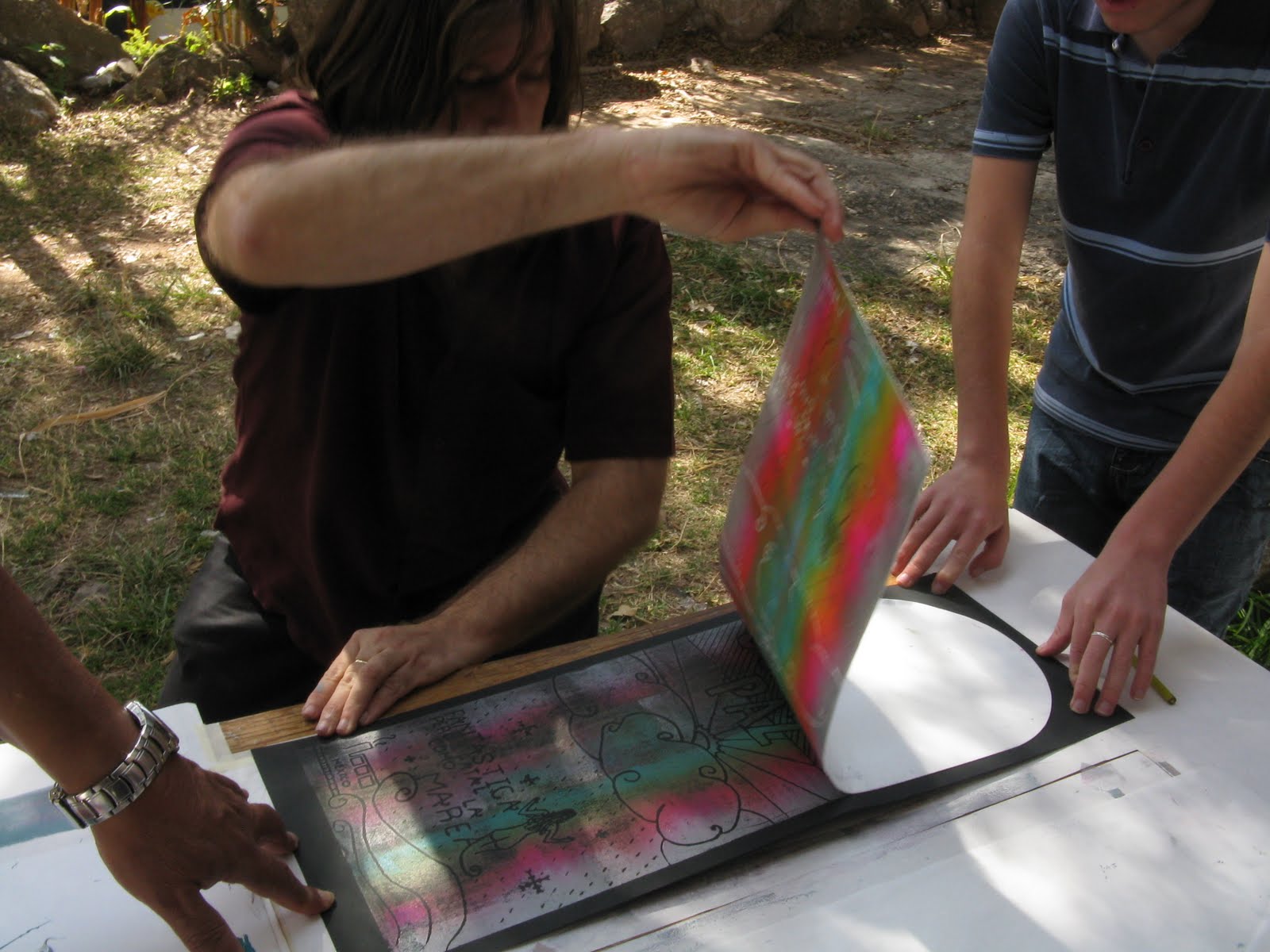
We were working in Port-au-Prince, Haiti, in the Petionville Camp tent-city, home to 55,000 people displaced by the devastating 2010 earthquake. The challenge was, can art, writing, photography and drama impact traumatized participants and provoke them to become leaders?

[John Paul Thornton and participants in the "Girls United: Haiti Through Our Eyes" project]

I worked on a remarkable arts project in Haiti. It was sponsored by the United Nations Foundation and two partner humanitarian organizations: “Full Circle Learning” and “Merridian Health Foundation”. My official title was “Artist Advocate and Instructor.” I was invited to participate as part of an amazing team which included Photographer Nadia Todres, Actor Rainn Wilson, Psychologist/Writer Kathryn Adams, Novelist Holiday Reinhorn and Educator Valerie Velazquez. The project is called
“Girls United: Haiti Through Our Eyes."It was an intense, demanding project, both humbling and emotionally charged.
I kept a day-by-day journal and I think the first entry gives a descriptive feeling of the scenario and experience:

[Little Haitian boys peer into a make-shift tent that became our "sacred Space']
Day 1: The Sacred Space
At the end of the narrow muddy road, there stood a modest makeshift tent.
Our team had cautiously trudged through a winding, claustrophobic maze of shanties that formed a silver sea of corrugated metal scraps and weathered vinyl tarps. 55,000 people lived here in the petionville tent-city, and a few hundred or so had been able to watch our slow progress past their dwellings, laughing good-naturedly with us when we slipped into the ankle-deep muck and then offering a kind hand to steady us as we proceeded. The stern faces of old women would light up radiantly when we sang "bon jour!." A sunny little bare-foot girl with corn-rowed hair ran ahead of us, directing us past nursing mothers, scrambling over smashed cinder-blocks and prancing in-between desperate little dwellings which housed the refugees of Haiti's unforgiving, disastrous earthquake.


Past the noisy boys playing with rusty bottle caps, past the man with one leg, beyond the chickens and the babies and the mango baskets and wandering water-gatherers, we crossed a bridge over a deep sewage trench to arrive at the modest makeshift tent.
"This is it!" called Kathryn Adams, our team leader. "This is where we will work." Tiny children peered at us from within, through tears in the tarp walls. A lazy white dog snuggled contentedly upon the damp mud floor under four long wooden benches which would serve to seat our new students.
Open spaces in the tarps let sunlight into the interior, and through these "windows," we could glimpse lush tropical trees and the tent city, rambling up the hillsides around us.
A sacred space can happen anywhere. The physical construction is almost irrelevant. The most vital element is the fostering of safety. This humble tent, twenty feet wide and fifteen feet long would become our sacred space in which visual art, writing, photography and theater would take place. For a while, this bland makeshift structure, perched beside the latrines on a twenty five degree downward dirt slope would become something magical: a safe cultural center for young Haitian girls.
The anticipation and excitement in the air grew as our participants arrived. There were even more girls than we had planned for! Gathering into groups, we presented them with our program: each day would consist of creative writing in specially prepared journals, learning to compose and capture personal images on digital cameras, and creating colorful thematic works of art. Dynamic theater exercise would round out the day.

As leader of the visual arts workshop, I introduced the girls to our first project; drawing designs into soft sheets of metal. "What is beautiful about Haiti?" I asked them. Without hesitation, the girls entered into a state of thoughtful, serene creation. None of them had admitted to considering themselves as being artists, yet all of them drew intricate depictions of flowers and trees. The calmness and care that they displayed showed me that my workshops would be about a quiet sense of safety and groundedness. I put aside my grand plans and let them experience the simple joy of transforming plain objects into art. The lesson was truly about transformation. "Tres belle," I said to each girl. "Very beautiful. See how easy it is to transform something?'" My words would break the silence, momentarily, as they looked up smiling.

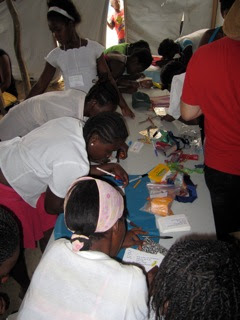
Some of the girls had not used crayons before. They were amazed when they saw some that I had brought.
Around us, our tent was a flurry of activity, each workshop tapping into different emotions and different styles of expression...

{Learning to photograph the world around them, participants in "Girls united; Haiti" developed a sense of their own personal vision. Team Photographer and educator Nadia Todre was amazing and empowering.]
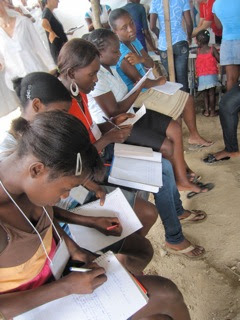
[Through expressive writing, the girls were able to safely explore their feelings and share them with each other. The themes ranged from intimate and simple observations of life in the camp, to eloquent, emotional poetry, reflecting deep, national pride and hopes for a better future.]

[The brilliant Rainn Wilson brought the atmosphere to life with his theater exercises, designed to strengthen the girl's confidence and bring laughter to the workshops, which, by nature, were becoming quite intense.]

[ Once Rainn Wilson had taught us all to let loose, I joined along in a game where we would all imitate the leader's actions and vocalizations. It was so joyous and fun! ]
Day 11: Presentation and celebration
For a culmination, our makeshift-tent was transformed into an exhibition space! The participants hung the artwork and printed copies of their digital photos.


The girls read some of their most moving poetry aloud to family members. We served cake and sang.


Kathryn Adams and Holiday Reinhorn left an indelible effect in the hearts and minds of the girls. They were writing coaches, emotional guides and confidents, bringing peace and focus into the camp.
A sister site, at a local YWCA hosted the Girls United project as well. The energy was freer, more playful and just as satisfying as working in the Petionville camp. The warmth and playfulness of the girls was inspiring.


As an artist it was remarkable to be able to experience the force of creativity in a country as rich and emotionally-charged as Haiti. As an educator, I learned so many important lessons from my fellow team-members and the participants.


This colorful anthology of the
“Girls United: Haiti Through Our Eyes"project features gorgeous artwork, photography and written poetry from the participants. it is available for purchase, with proceeds going towards continuation of the programs. Click the link to see it!
All photography featured in this post copyright 2011 "Girls United: Haiti Through Our Eyes" Nadia Todres and JP/HRO